
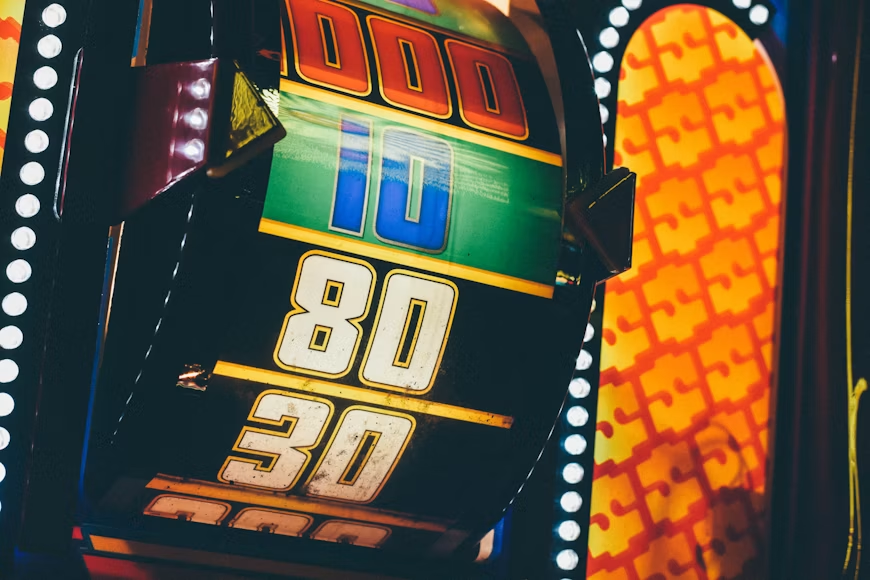
For some people, traditional money wheels can lose their edge after a while. While the outcome is totally random, the process itself can start to feel a little predictable, repetitive, clunky, and in need of a shake-up.
Enter: the digital multiplier engine, which sits quietly above the physical studio action. We see the main wheel as the centerpiece, but then there’s the added algorithmic layer of Crazy Time Live where base payouts get completely rewritten on a casual Tuesday afternoon.
The Mechanics of Pre-Spin Coupling
What you end up with is a system called the Top Slot: an automated, two-reel random number generator mounted right over the physical 54-segment wheel, operating on its own separate clock cycle. Before the host spins the actual wheel, these two digital reels start ‘spinning’.
The first reel is programmed to select an outcome, which can be a standard base number or one of the studio’s specialized bonus segments, while the second reel rolls for a potential multiplier value. They need to align horizontally across a single central line to lock in. If they misalign, the round proceeds as a standard spin, which keeps the mathematics balanced.
But when they do snap into place, that specific multiplier is locked onto that specific segment before the physical wheel even begins to slow down. It happens fast.
As a player, you need to process multiple distinct layers of probability simultaneously, watch the digital reels settle into a combination, check your open stakes, track the physical leather flapper, and calculate the final returns.
Elevating the Base Grid Numbers
In all honesty, the real genius of this setup is how it rescues the low-tier numbers from being absolute dead weight on your betting slip. Normally, betting on a number 1 or a number 2 is a defensive, uninspired strategy designed to maintain your bankroll as long as possible. It is the casino equivalent of ordering the chicken because you are scared of the menu.
The Top Slot changes that dynamic by introducing the possibility of big scaling on mundane outcomes. It breaks the traditional risk-reward curve. Suddenly, a number 10 segment transforms way past its base ten-to-one payout. If the digital reels overhead pair that 10 with a massive multiplier, that boring utility bet gets supercharged into an outcome that easily out-pays standard flat-rate casino rewards.
You find yourself rooting for a basic number 2 because the digital overlay transformed it into a temporary powerhouse, creating a wild discrepancy between the physical size of the wheel wedge and the actual financial payload it carries.
It turns the lowest common denominators on the board into high-stakes wildcards, ensuring that the primary loop stays active and unpredictable even when the wheel avoids the bonus wedges for a few spins.
The presence of the Top Slot completely warps the player’s traditional risk-reward strategy. In a standard gaming setup, you look at a board and expect the high-frequency segments to pay crumbs, while the rare segments handle the heavy lifting. The multiplier overlay throws that distribution right out the window. What you end up with is a highly volatile environment where a simple number 2 can randomly hit a massive multiplier, outperforming what an unmultiplied bonus round would have paid out in the first place.
This mechanical shift turns the low-tier numbers from boring bankroll-maintenance tools into the primary engine of sudden, unexpected spikes. It rewards defensive betting styles with offensive payouts. Players actively look forward to the base wheel rotations, knowing that every single spin carries the statistical potential of an inflated payout on a high-coverage segment.