
People still talk about those moments when you’re walking down some tight alley at dusk. Suddenly a mural pops up on the wall next to you. Its made from shifting lights and shadows. You try to get closer. But it fades away into the bricks. A bit further along another one shows up. This ones different. Brighter. And it vanishes just as quick. These are like graffiti ghosts. A fresh kind of digital street art. Brought to life by AI photo generator tools by Dreamina.

Its not your usual spray paint stuff. This art moves. It changes. Then it’s gone. Street artists are turning plain walls into something alive. They swap out cans of paint for code.
When walls learned to whisper
Graffiti was always about pushing back. About who you are. About raw emotion. Artists take over walls without asking. They make the space their own. But these days the walls answer. Generative tech lets murals fade and come back. They react to things around them. Like people moving by. Or changes in light.
Picture a poster that only lights up when someone passes. Or when the streetlamp kicks on. Its not stuck in place anymore. These pieces fit right into the citys beat. Stories that show up when they matter. Then slip away. Art that knows when to hang back. This twist adds a kind of poetry to it all. The way it fades makes every view personal. Like the wall is responding to you directly.
Merging tech with texture
What makes this cool is how it mixes rough surfaces with digital tricks. Artists snap pics of real walls. All those textures. The way light plays. Then they layer in AI creations. The result feels both techy and real human. With an AI logo generator they craft signs that pulse. Logos that breathe into view. Maybe a brand mark that only appears in the rain. Or after dark. These shifting symbols make ads into tales. Not just sales pitches.
When the logo melts back into the wall. Leaving streaks of color or blur. It’s like a soft hint of design. Quiet but sticks with you.
From still posters to breathing canvases
Street posters are changing beyond the printed page. With projection mapping and motion sensors, artists are casting digital images onto surfaces in a new way. Rather than peeling away or degrading over months, these posters fade by design, their disappearance is an integral part of the message.
Graffiti ghosts confront us with our relationship to permanence. They tell us that art doesn’t have to last an eternity to be important. In fact, its impermanence makes it all the more valuable.
Dreamina’s eerily imaginative guide to generative graffiti
Let’s see how you can create your own “graffiti ghost” idea with Dreamina.
Step 1: write a text prompt
Head over to Dreamina to begin (this is not an image generator). You will start with a text prompt, so think through a detailed text prompt that articulates your vision. The more detailed and descriptive you are, the better the AI will understand the mood, the context, and what the texture of the art might look like.
For example:
“Create a street poster that looks like ghost graffiti forming and evaporating on a dirty brick wall. Use neon blues and smokey grays and have a lightly visualized human form melting into the fog. The image should be ghostly, but beautiful, blending real art with surreal movement.”
Dreamina takes the text prompt and builds a powerful visual reference.
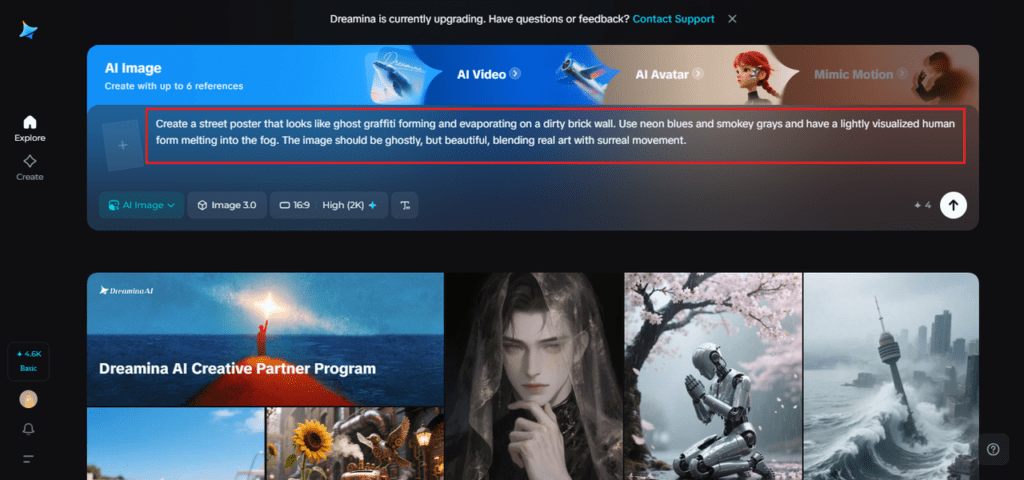
Step 2: tweak parameters and create
Next, adjust the parameters to shape your output. Choose a model that corresponds to your visual vibe, adjust the aspect ratio according to your poster layout, and select the size and resolution, 1K or 2K for a focused street-level image. Once everything is ready, click the Dreamina icon to create. In a few seconds, your ghostly artwork will emerge, colors blending together, textures on the digital wall pulsating. It is akin to seeing and making graffiti emerge in the digital space, while waiting for the right moment to haunt the city scape.

Step 3: customize and download
Now let’s start creating. Take Dreamina’s professional-grade editing functions to perfect your work. Use inpaint to remove unwanted details; expand to stretch your scene beyond its borders; remove to take things out; and retouch to touch up dimensions and lighting.
When you feel confident about the look of the piece, click “Download” and save your ghostly graffiti poster. You can then project, print with light-reactive ink, or use digital boards, sure to fade in and out as if it were a living apparition.

The pulse of invisible art
Graffiti ghosts kind of capture that pulse of city life these days. They are moving, full of feeling, and they do not stick around for long. Cities turn into these big spaces to hold onto memories. Art that fades away, it really mirrors how we live, all temporary and charged up, changing things as it goes.
Artists mess around with AI poster generator to test out those shifts. Colors fade out slow, textures get blurry, shapes hint at being there then vanish. Each poster turns into this trial run for emotions, built by code but felt deep in your gut. Tech like that does not push creativity aside. It boosts it up instead.
From ghosts to growth: why artists love Dreamina
Dreamina, it is no simple tool. More like a sidekick for wild ideas. It gets the vibe of dreaming big, lets you build things that do more than sit there. They shift, they dim, they seem alive. Artists use it to mix up defiance with pretty sights, mess with calm in the storm.
Graffiti goes generative, and the wall starts telling tales. City becomes the backdrop. So picture art that shows up only when breeze hits or sun angles right on the surface. It can happen. Dreamina helps turn hidden thoughts into glowing moments. For street ads, walls that react, or setup online, it teams up to shape the coming rush of city voices.